
What is the Difference Between Accounting Services and Bookkeeping


Introduction to Accounting and Bookkeeping
Finance management is a very important aspect of any business and it is vital to know the different roles that accounting and bookkeeping play. Although the two functions are closely related, they deal with different issues of financial management.
The main concern of bookkeeping is to keep the trace of the daily financial activities of a business in order to have a consistent and accurate record of all the money brought and money going out of the company. Accounting, in its turn, is based on this foundation but encompasses the analysis of the recorded data and the discovery of trends in it to provide directions in decision-making and denote the possible problems.
The two are essential to the financial well-being of a business; however, there is a great difference between the desired results and the direction taken by each one. Accuracy and consistency are central to bookkeeping, as they are the means of ensuring that the economics data is complete and arranged.
Accounting however does not end with organization and it offers insights that assist the business owners to assess performance, growth strategies and maneuver financial commitments. Through these roles distinction, the businesses will be in a better position to utilize resources to effectively control money.

Core Functions of Bookkeeping
Bookkeeping is the process of maintaining financial transactions of a business in a well-organized manner in order to ensure that all the data is updated. This entails keeping the records of sales, purchases, payments and receipts which are normally keyed into accounting programs or books. Maintaining a proper record of such transactions, bookkeepers form a very strong platform, which helps in other financial operations.
Another important factor in book keeping is the number of accounts that are reconciled in order to ensure that the transactions recorded are equivalent to the bank statements, credit card statements, and any other financial statement.
This assists in detecting any differences at an early stage, which lowers the probability of making mistakes that are capable of affecting the financial report of a firm. Moreover, bookkeepers usually prepare payrolls, keep invoices, and keep track of accounts receivable and payable so that the payment is made within the required time.
Another task of bookkeeping is to group the transactions into the right categories and place them under the right accounts to simplify the financial reporting. This detail is a necessity to have a well-organized and transparent system of records keeping. Having such well-kept records, the businesses may easily trace the cash flow and can keep track of their financial standing at any time.

Core Functions of Accounting
Accounting is concerned with converting financial documents into practical wisdom. This involves data interpretation with the aim of creating patterns, trends and areas of improvement in a business.
The monetary transactions that have been documented by bookkeepers are used by the accountants to come up with reports including income statements, balance sheets, and cash flow statements which gives a clear picture of the financial position of a business. These records are needed to analyze profitability, control costs and determine the performance.
The other important role of accounting is the provision of adherence to the taxation laws and financial regulations. Accountants are involved in the preparation and filing of tax returns, recommended deductions and to ensure that businesses do not pay more taxes than it is legally required. They also make sure that the records in financial matters are in standard practices and this is important to achieve transparency and regulatory standards.
Other roles accountants have to deal with are budgeting and forecasting. They should use historical data and trends in the market to guide businesses in planning their financial requirements in future, as well as efficiently allocate resources and establish achievable financial objectives. Such future-thinking methodology helps to prevent the possible difficulties and take advantage of the development opportunities.
Audit is also done by accountants to confirm that financial records are accurate, and all information is credible without any contradiction. Through internal audits and identifying wrongs or irregularities, they may help in ensuring the integrity of financial systems.
Besides these functions, the accountants normally offer advisory services, which are dependent on the financial position of a business. They can be helpful in making investment decisions, risk management decisions, or cost minimization strategies. With this direction, they enable the businesses to take sound decisions that are in line with the long-term goals.
Good accounting is the ability to summarize the complicated financial information into recommendations, which can be put into action, enabling the business owner to make decisions confidentially. Accountants provide important insights on the basis of the numbers that go beyond record-keeping and assist in the overall success of the organization.
Key Differences Between the Two
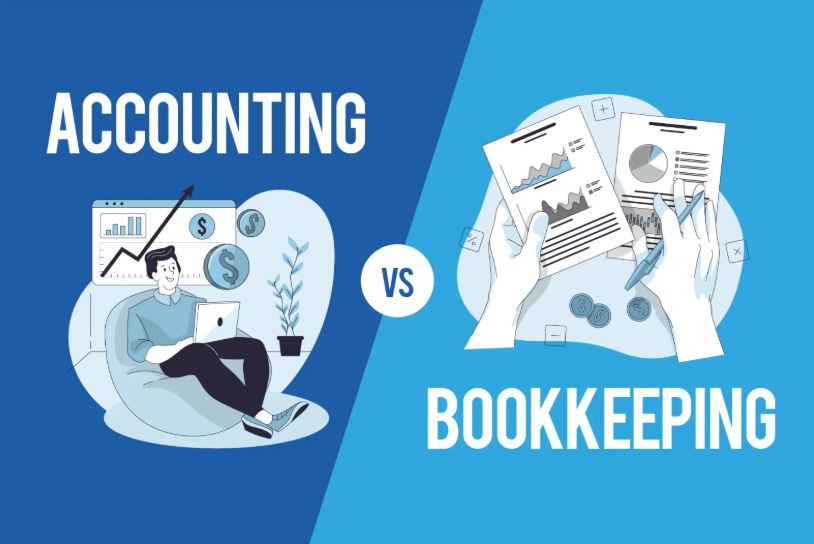
The difference between bookkeeping and accounting is huge as regards purpose, duties, and expertise of either role. The focus of bookkeeping is keeping a financial record of financial transactions in a systematically and accurately documented way.
It is a process which includes the input of data, classification of the expenses and income and the maintenance of the well-organized records which can describe the everyday financial activity of business. Bookkeeper tools and systems are mostly transactional, and are aimed at capturing and tracking numbers with precision.
Accounting on the other hand is concerned with the interpretation and the use of the information that is given by bookkeeping. The wider view of the accountants is the analysis of the documented financial data in order to draw up all-encompassing reports and insights.
Such reports as income statements and cash flow analysis allow businesses to determine the general financial position, the areas of improvement, and make appropriate decisions regarding future development. Whereas bookkeeping focuses on uniformity and thoroughness in accounting, accounting also uses a greater degree of judgment and skill to verify that the information is meaningful and valuable to act on.
The other major difference is in the degree of technical knowledge required. The bookkeepers should be conversant with record keeping systems, computer software and financial documentation standards. Their position may require a methodical approach and concern with precision in order to make sure of the trustworthiness of their records.
Accountants, on the contrary, need to be more knowledgeable on financial principles, regulations on taxation and strategic planning. Their duties frequently involve the recommendation of businesses financial strategies, compliance and cost management.
Moreover, the time and the extent of every operation vary. Bookkeeping is a continuous exercise, which demonstrates the financial activity of a business at once. Accounting can however be done periodically, e.g. monthly, annually to consider the economic performance during a particular period.
This is the regular review that allows accountants to make strategic suggestions based on trends and patterns in the information. These differences make clear the complementarity and distinctiveness of these two financial roles.
How They Work Together
Although bookkeeping and accounting operate in different capacities, interdependency is the reason why the two can enable businesses to have a healthy financial system. All accounting processes are based on the economic data that is carefully documented by bookkeepers.
A well-organized and accurate system of daily transactions through bookkeeping ensures that there is a smooth stream of information that can be analyzed further by the accountants.
Accountants and bookkeepers tend to work together towards the optimization of the procedures and to meet the financial demands of an enterprise. As an example, when bookkeepers review the balances of an account, they might raise red flags when they find something out of the ordinary or irregular and the accountants can go into details and find out the effects of the same on the overall financial scenario. Such cooperation reduces the chances of making mistakes and makes financial records credible.
The other means through which they collaborate is through reporting. Bookkeepers ensure the raw data that is required to create the necessary financial documents, and accountants use this data to create the full reports which may be profit and loss statements or tax filings. In the absence of accurate bookkeeping, accountants would have problems with developing credible evaluations and projections.
Moreover, the two roles will help in enforcing compliance. Bookkeepers monitor and classify the data that will be required in the regulatory requirements, and accountants interpolate data to complete tax obligations and ensure that financial standards are observed. Such partnerships assist companies in avoiding fines and staying accountable to their stakeholders.
Besides compliance, financial planning is also facilitated by this dynamic between the two functions. Bookkeepers do the preparation work by classifying and documenting the costs, income, and other activities.
This detailed information is then used by accountants to predict the future financial needs, analyze the investment opportunities and prepare budgets. These functions alone give an entire view of the financial status of the business and thus informed decisions can be made.
The cooperative nature of bookkeeping and accounting is important to ensure that businesses are able to trust the quality of information and strategic business insights. This efficiency and reliability of financial management is improved by their integration to meet the short-term operation requirement and long-term planning.
Choosing the Right Service for Your Business
Choosing between bookkeeping and accounting services is highly dependent on the special needs of your business. Bookkeeping is also vital with regards to ensuring proper up to date records of daily transactions especially when it comes to smaller firms or those that are still in its inception process. In case your major concern is having your financial information properly structured and easily available, you can consider investing in bookkeeping services.
Accounting services offer the direction and planning of a business or business intending to have a better understanding of the business finances. It is possible to use accountants to prepare taxes, comply with taxes, budget and provide financial forecasts, which makes their skills helpful in businesses that need to operate in sophisticated financial situations or project long-term objectives.
The decision between the two is also subject to the number of financial controls that your business needs. Whereas bookkeeping is the foundation and tracks the transactions, accounting is a wider scope to interpret and guide the decision making.

In the case of most companies and those that are undergoing growth or transactions that involve large volumes of money, the integration of the two services guarantees the company a smooth financial management system that facilitates the day to day running of the business and the planning of the business.
When making a decision, keep in mind such variables as the size and complexity of your business, the sector in which your business will be operating, and the financial difficulty you are trying to overcome. By outsourcing your bookkeeping and accounting to qualified people, you will save time and minimize the chances of mistakes thus giving the time to focus on running your business.
To be more comprehensive, other firms prefer to engage the services of professionals that may make use of both functions and make sure that the same level of consistency and accuracy exists during the process of recording the first transaction till strategic financial recommendations.
Evaluating the needs of your business in the present and future will help you to realize what kind of support you need now and, in the future, and adopt financial practices that are consistent with your objectives. This practice creates stability and development, which provides your business with the means to prosper.
For more details on how our bookkeeping and accounting services can support your business, visit our Accounting & Bookkeeping page.